
欢迎关注舒朋士
微信公众账号

1. Project Overview
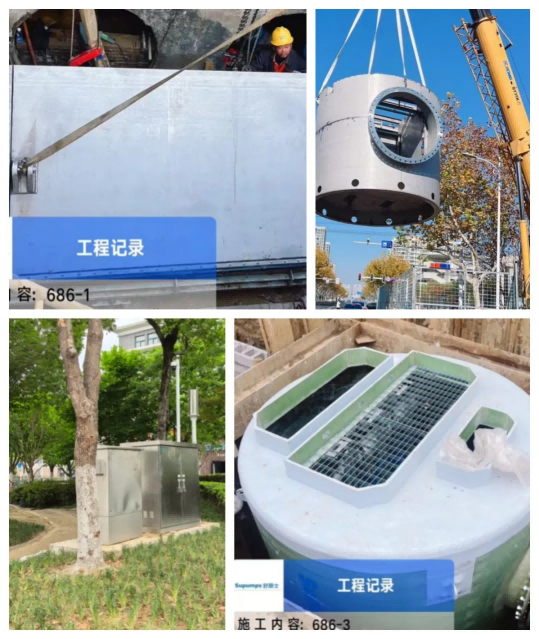
As a key construction project under the 14th Five-Year Plan for sewage treatment efficiency improvement in Liyang, this project addresses overflow pollution from combined sewer networks. Seven sets of integrated intelligent interception lifting wells (J1-J7) are deployed along the Danjinli Canal, Nanhe River and urban main roads, covering densely populated and environmentally sensitive areas including residential quarters and schools. A comprehensive pollution prevention system is built to eliminate rainwater-induced raw sewage discharge and continuously improve urban river and lake water quality.
2. Project Pain Points
The southern area of Liyang is covered with extensive combined sewer pipelines. Rainfall surges the volume of mixed rain and sewage, exceeding the capacity of interception facilities and causing raw sewage overflow into rivers. Groundwater infiltration also triggers sewage overflow even in dry weather, resulting in persistent water pollution. A dynamically adjustable and long-term stable source interception solution is urgently needed.
3. Supumps Solutions
*1. Deployment of Integrated Intelligent Interception Lifting Wells
Supumps integrated intelligent interception lifting wells are installed at drainage outlets to intercept sewage efficiently at the source and block untreated sewage from flowing into rivers, reducing pollutant inflow into water bodies.
*2. Dynamic Intelligent Control System with Tilting Gate
Matching tilting gate equipment dynamically adjusts overflow weir height and flexibly regulates interception ratio: the interception capacity is boosted under high-flow conditions to reduce overflow, while intelligent scheduling is optimized under stable flow to achieve precise and efficient sewage interception adapting to fluctuating water volume in sewer networks.
*3. Advantages of Integrated Design
Factory prefabricated equipment shortens on-site construction cycles and lowers construction difficulty. Complete intelligent configuration enables automatic operation of drainage systems to support long-term water environment governance.
4. Project Value
The project effectively solves overflow pollution from combined sewer networks and forms a standardized model for urban drainage outlet governance. The combined solution of integrated intelligent interception wells and dynamic tilting gates adapts to complex water volume conditions with high replicability and promotability, offering mature solutions for domestic urban pipe network efficiency upgrading and long-term black & odorous water treatment.
1. Project Overview
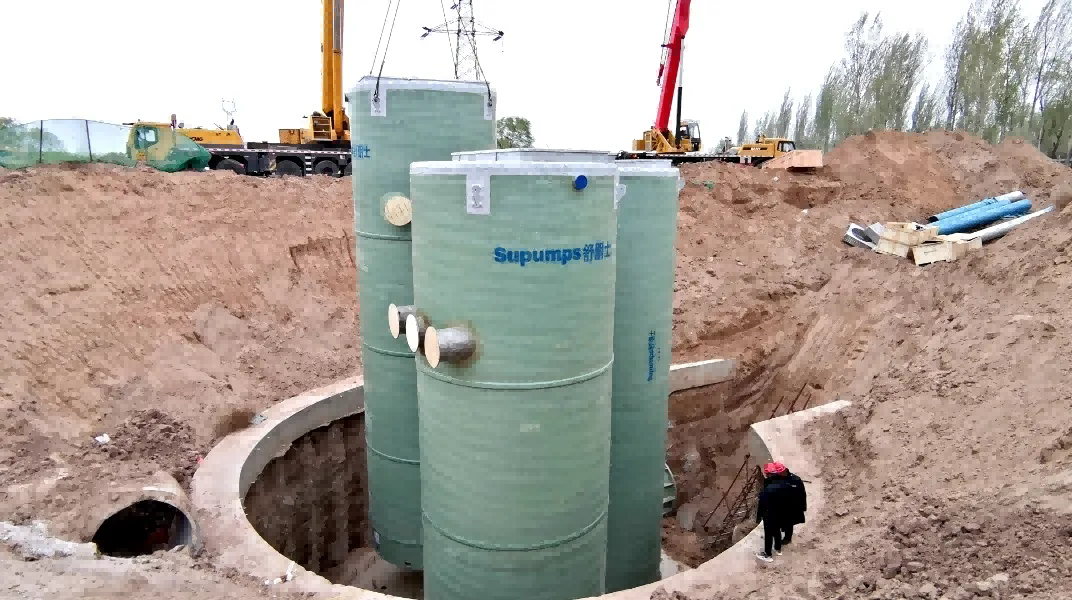
This rainwater drainage project serves the underpass interchange of Erguang Expressway on Jinzhong Comprehensive Passage, located in the starting zone of Jinzhong Modern Industrial Park, a key traffic node of urban expressways. Adopting a dual-cylinder parallel integrated prefabricated rainwater pumping station, it covers a catchment area of 6.0 ha with a design flow rate of 2.5 m³/s and total daily treatment capacity of 216,000 m³. Sited in the green belt on the east side of the road, the pumping station collects and lifts rainwater from the underpass interchange, improves the drainage system of urban traffic networks and guarantees safe passage at the interchange.
2. Project Pain Points
The underpass interchange sits at a low terrain with steep longitudinal slopes on both approach roads, leading to fast water convergence during rainfall and massive waterlogging under heavy rainstorms. As a critical urban traffic hub, waterlogging will directly interrupt traffic, imposing far higher requirements on drainage capacity and operational reliability of the rainwater removal system than ordinary road drainage projects.
3. Supumps Solutions
*1. Customized Multi-cylinder Parallel Design
The complete system consists of 1 Φ3.0 m ×13 m grating cylinder and 2 Φ3.8 m ×13 m pump cylinders connected by pipelines. Each pump cylinder is equipped with 3 pumps to form a parallel large-flow rainwater lifting system satisfying drainage demands under severe rainstorms.
*2. Front-mounted Shredding Grille
A shredding grille is installed at the water inlet of the grating cylinder to crush large debris in rainwater, preventing subsequent pump blockage and ensuring stable long-term system operation.
*3. Compact Layout
The pumping station is arranged in the road green belt with a small footprint, adapting to limited construction space for municipal roads. Factory prefabrication and fast on-site assembly drastically shorten construction periods.
4. Project Value
This project is a benchmark case of large-flow rainwater drainage for underpass interchanges, verifying that multi-cylinder parallel integrated prefabricated pumping stations can meet high-intensity drainage demands of key urban traffic hubs. Compared with traditional concrete pumping stations, it features shorter construction cycles and smaller land occupation, providing mature solutions for rainwater treatment of domestic underpasses and interchange roads.
1. Project Overview
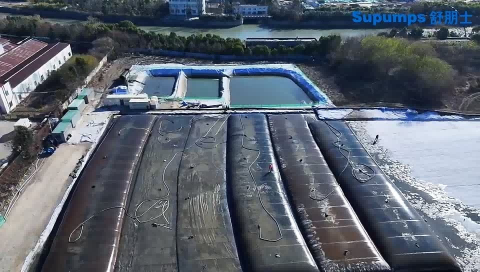
Sanjing River, with a total length of 3.5 km, is a core flood discharge and ecological landscape river in the high-tech zone of Xinbei District, Changzhou. The river suffers sediment deposition ranging from 0.2 m to 1.5 m with an average depth of 1 m, narrowing flood cross-sections and worsening water quality. Full-length dredging is implemented along the 3.5 km river with a total dredging volume of about 28,500 m³ (in-situ volume). The project applies Supumps container skid-mounted high-dryness sediment dewatering online treatment system to realize on-site volume reduction, harmless disposal and resource utilization of sediment, recover river flood discharge capacity and improve urban water environment.
2. Project Pain Points
Located in the downtown area, the project faces prominent construction constraints:
*1. Limited construction space makes it impossible to deploy large traditional dredging and drying equipment;
*2. Strict environmental protection standards are enforced in sensitive urban areas, requiring zero leakage, no secondary pollution, controlled noise and dust to minimize disturbance to surrounding residents;
*3. Complex construction conditions include tight available space, short effective construction periods and limited power supply;
*4. Traditional wet sediment transportation via tank trucks carries high leakage risks and high transit costs.
3. Supumps Solutions
*1. Skid-mounted Container Integrated Treatment Equipment
Modular equipment allows rapid disassembly, transportation and commissioning with simple entry requirements – operation can start after site leveling, water and power supply. With a total power of 55 kW and a daily processing capacity of 1,200 m³ in-situ sediment, it meets the demand for short-term high-efficiency construction in urban areas. An intelligent control system supports automatic dosing and continuous operation.
*2. In-situ Dewatering Process with Geotextile Tubes
Sediment is delivered to geotextile tubes via closed pipelines without tank truck transit, greatly lowering leakage risks. Enclosed dewatering construction generates low noise and dust with stably compliant tailwater discharge. Sediment volume is reduced by 80% after dewatering with moisture content below 55%, meeting standards for external transportation and disposal.
*3. Resource Utilization of Sediment
Dried sediment after dewatering can be used for road subgrade filling, green planting and organic composting, realizing sediment volume reduction, harmless treatment and resource recovery.
4. Project Value
This project serves as a typical model of in-situ sediment treatment for inland rivers in downtown urban areas, verifying the practicability of skid-mounted geotextile tube dewatering technology under narrow, highly sensitive urban working conditions. Compared with traditional processes, it improves processing efficiency and cuts comprehensive costs by 25%~30%, offering mature replicable solutions for domestic happy river-lake construction and internal pollution treatment of urban rivers.